Drupal 7.14

20387 votes cast

Category: CMS / Portals
Stable Release: 7.14
Started In: 2000
Updated: May 11 2012
Native Language: English
License: GNU General Public License (GPL)

Drupal Description

Drupal is open source software maintained and developed by a community of hundreds of thousands of users and developers. It's distributed under the terms of the GNU General Public License (or "GPL"), which means anyone is free to download it, share it with others, and contribute back to the project. This open development model means that people are constantly working to make sure Drupal is a cutting-edge platform that supports the latest technologies that the Web has to offer.

Drupal is a publishing platform created by our vibrant community and bursting with potential. Use as-is or snap in any of thousands of free designs and plug-ins for rapid site assembly. Developers love our well-documented APIs. Designers love our flexibility. Site administrators love our limitless scalability.

Demo will be deleted and re-installed in:


Drupal Demo

Sending/receiving email is disabled on all demos
Demos are the 'basic install' only, no add-ons, no content
Admin Username: admin
Admin Password: demo123
Is this demo broken? Report as broken
Need a re-install? Request re-install
Watch Free Drupal Tutorial Videos
opensourcecms.com is now offering free streaming video tutorials showing you step-by-step how to manage Drupal. These free streaming videos will show you how to manage blocks, configure options, install Drupal via Fantastico, manage plugins, change Drupal passwords and much more.

Post A Comment

Name:
Comment:
Human Verifier:
(enter the 4 blue numbers you see above)
 
Error! Invalid human verify code
Thank you for your comment. After we have reviewed your comment (to make sure it is not spam) it will be posted below.
Advertisement

Drupal Comments

big67
Sep 25 2009, 11:00 am
Hi there

I am using Drupal since some years (D4, D5, D6) and I am really satisfied with it.

The learning curve is somewhat steep, but overall manageable.

A fresh drupal install like the demo here is just an empty shell, and does not provide any real world functionality.
I do not think it makes sense to evaluate Drupal from this demo install.

In fact, the first concept to understand of Drupal is its modularity, that is you need to install each module-functionality you need. You have 1000s of ready to use modules, all free and open source, but you will need to select and install each one of them separately.
Often you will need to test 2 or 3 modules with overlapping functionalities.

The process is easy, just upload - activate - configure, it IS time consuming, but on the up side of this process you get a detailed understanding of each module, and, most important, the interactions of the modules with each other is CLEAR.
And you do not install anything you do NOT need.

@Jean: yes some of the things you say make some sense: there is truly the need to find a new way to develop new modules, and the modules development is community driven that is, anarchycal.

The upgrade process? But you do not NEED to do this for all the modules! If your website works, why update the modules??? Just update the core for known security issues: the core updates do not add any functionality, so you will not have any issue with the modules.

I did it some times, it is easy. Turn maintenance on. Turn modules off. Upload new core. Turn modules back on. Turn maintenance off. On a fairly complex D6 website it took 1/4 hour or so, that's it.

About your comments on templating: you are completely wrong.
It is easy to adapt and develop templates for Drupal.
There are wonderful Drupal templates.
And the new release of Artisteer lets you visually develop new templates for Drupal 6, that is you can develop a template from scratch in minutes. Artisteer is 120 bucks away.

Speed: Drupal can be fast or slow depending on the hosting. I am using a shared Linux hosting (I pay 30 Euro per year for hosting 1 website, including MySQL support) with Drupal 6 and a good amount of modules (Gmaps, Videos, HTML editor...) and it is a charm. Use caching and compress the template (javascripts css).

The clumsy administration interface: just install an admin module! I have a AJAX admin that is an ass kicker!
Fred Riley
Sep 11 2009, 10:48 am
I've been evaluating CMSs for a simple website I run which desperately needs to be put into a CMS to allow authors to 'own' their content without going through me as the webadmin. I also wanted built-in systems such as news and events databases, and version rollback.

Drupal does, going by the feature list on its enthusiastic website, do this and much, much more, but my major headache has been trying to exactly control the website interface. Sure, there are loads of themes available, but I don't want to use them, I want to use my own interface with its painstakingly-crafted CMS. To do this, though, I have to dissect the CSS and PHP files used, which requires an in-depth understanding of themes, which in turn requires a good understanding of how Drupal works, which requires spending serious time with the patchy documentation.

From what I can see, it's a very fine CMS which has more features than a pomegranate has pips *if* you have the time to immerse yourself in it and write extensions in CSS and PHP. You can create super-sophisticated sites fairly quickly if you use a ready-rolled theme, and its a good solution for those in a hurry and under pressure from clients. However, I want to *save* myself time but at the same time have complete control over the site CSS, and it boded ill that after 5 hours I still couldn't understand the system (and I'm an experienced web developer and CSS and PHP coder). With the amount of time I'd need to spend on Drupal to get it to bend to my will, I might as well write my own simple CMS for my colleagues.

Conclusion: the dog's bollox, but a steep learning curve which requires time and dedication.
Colin
Sep 9 2009, 3:58 pm
It looks like Jay August is one of these 'Drupal evangelist' claiming everywhere that Drupal CMS is good, is great, is wonderful. But never they bring any evidences.

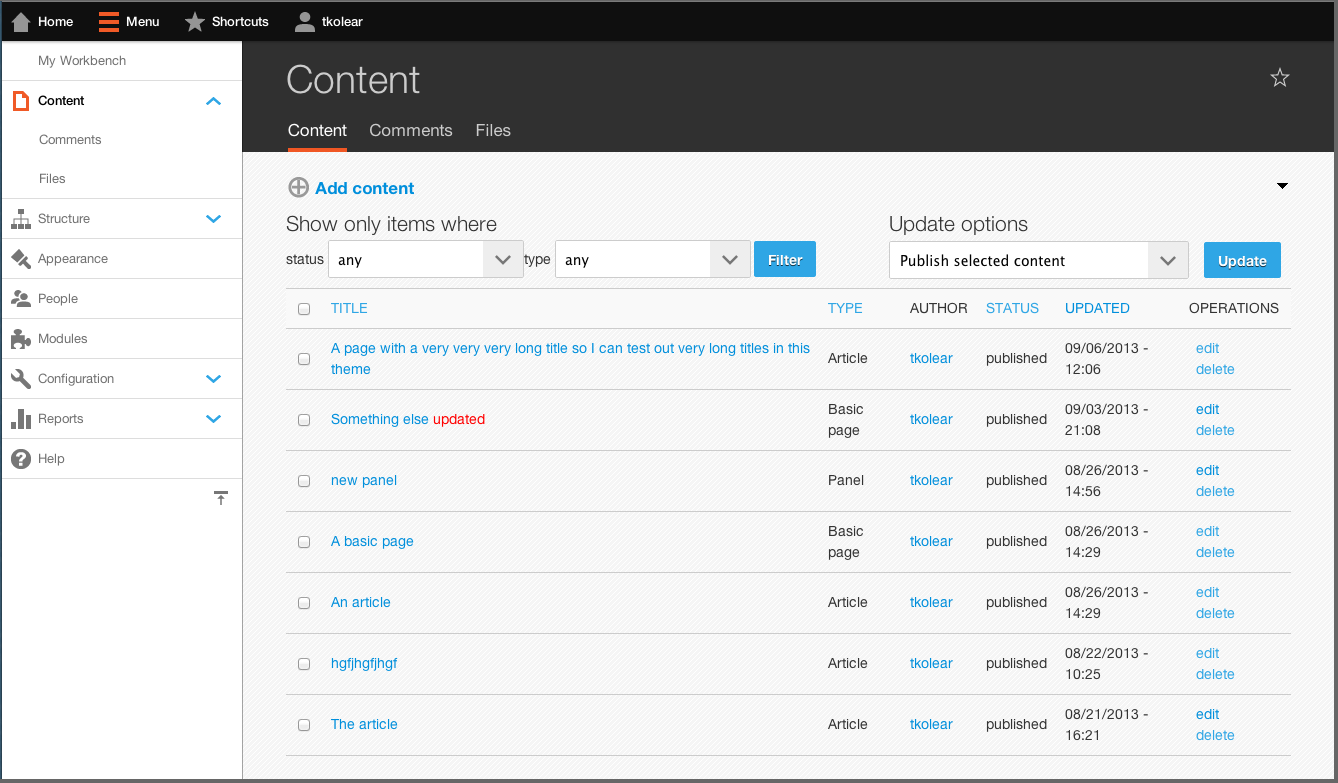
Drupal is a CMS of medium class. Not the worst, not the best. It has a very unfriendly administration, it is slow, and has very little feature in the core.

One can add numerous features through additional modules. But yes, modules are a big issue. For example you will need to install several modules if you want pictures on your site. Not one sole module, but several. Same for music, videos, multilingual, editor, etc.
At the end one can have over 100 modules to have a decent site.
Problem is that these modules are NEVER up to date when a new version of Drupal is released.

It is true also that the more you install modules the more Drupal becomes slow. Very slow. I have never seen that with other CMS (I did 22 sites using Joomla, Wordpress, Drupal, Expression Engine and ModX).
Drupal has a poor cache system and therefore speed become a critical aspect.

Regarding design, Drupal has no flexibility at all. Compare it to ModX or Silverstripe and you will see that you only loose a lot of time when you try to design Drupal.

But as said Drupal is not the worst CMS. It has strong SEO and blog features.
Basically I would say it is a blog CMS that tried to become a website CMS. But this includes all the drawbacks of such a move.
Jay August
Sep 2 2009, 8:10 am
A lot of things Jean mentioned are utterly crap. You can easily upgrade Drupal modules if you know how to use CVS, its template engine is extremly flexible and I don't think their years behind on anything, except the free themes that are available are dramatically bad, to just plain evil.

Drupal is a beast, but when tamed correctly it becomes a puppy that listens to you very well. I built 5 sites in Drupal, 2 in DP5 and 3 in DP6 and I just love it. It's hard to learn, but overcoming difficulties proved to be not a big task after all.

Upgrading from 5 to 6 is indeed 100% drama, I fully agree with that, but apart from that (which is a bad thing in itself, I know) the code is clean, versatile and easy to manage.

Also the part where he claims anarchy in coded modules is not true as well. Not sure what kind of exotic modules Jean used, but the modules that will be added to core in DP7 like Views and CCK are coded excellent, with a very high standard like one would expect.

so, from a Drupal fanboy: I like Drupal. It's a wild beast, but it works and it does its tasks very good.

And Drupal slow? Get better hardware, use proper cron jobs and cache your theme. It works, and it does that out-the-box.
Tony
Aug 26 2009, 12:41 pm
I'm an active drupal user for many years. Drupal is a very good platform for building web application due to its flexibility(Well, I know this is only true for developer). But I recently realize that drupal is getting slower and slower. So, I'm searching for a new platform for my future application. MODx is an interesting platform. I still learning about it.
Mad
Aug 26 2009, 6:37 am
Jean describes the Drupal problems well. The modules you need do not work often. I personally think the drupal website is a total mess. If you need some information, its probably for an outdated version and will not work with the latest major release. If you dig into the problem you can browse through pages over pages of discussion threads, and waste a lot of time. However Drupal is not a CMS alone, its a framework for building sites. You can code certain hooks into your scripts that get executed in time, much like the Javascript events.
If it was documented decently you could do a lot of neat stuff with Drupal. But the way things are, you better invest your time into something else.
Mark H
Aug 21 2009, 12:25 pm
I'm a Drupal novice. Thanks for all of the comments.
OpenSourceCMS
Aug 20 2009, 2:37 pm
Reply to nudge:

"Hiya, this is a very silly question but this comment section that we are writing in, is exactly what I want to use on a website basically comments on topics on a news story. Is this Drupal we are writing on now or something different? I have no experience in this hence the question!"

OpenSourceCMS created this comment system ourself, but there are many open source projects that allow user comments. As one of the people who check the comments on OpenSourceCMS, I would recommend finding one with some type of "human verifier" and a way to approve/edit the comments (if needed)

Mark
OpenSourceCMS
nudge
Aug 19 2009, 2:02 pm
Hiya, this is a very silly question but this comment section that we are writing in, is exactly what I want to use on a website basically comments on topics on a news story. Is this Drupal we are writing on now or something different? I have no experience in this hence the question!
Francis
Aug 15 2009, 6:47 pm
I have used Drupal. It is very good, BUT is has yet to have PHP 5.3 support. At least do so on Drupal 6 and 7.
Jason K.
Aug 12 2009, 3:15 pm
Sorry guys, with Drupal you cannot set up a website in minutes... unless you do not want any pictures, proper SEO, text editors, videos, music and so on.
True, you can have all these feature in Drupal (through additional modules), but then it will take you quite a while to get there AND you will see your site slowing down like crazy.
Drupal is awful when regarding speed.

Yes, Drupal has many features. Yes, you can do website with Drupal (hopefully!). But it is not user friendly, administration is crap and the technology is... outdated. YES!

Drupal has been a the top for years. This attracted a lot of developers to it, creating a huge community.
Obviously such a big community does a lot of noise claiming that this CMS is the 'best CMS'.
You can read all over the Web how perfect Drupal is. But guys, the World change every day, and the Internet too.
What was excellent 10 years ago is more than outdated today.

New CMS have been developped integrating the best of today's web technology. Drupal simply cannot compare with them.
To name only 2 of them: have a look at MODX or Expression Engine. Both of them have stable release that already are much more powerful than Drupal.
On top of that both of them will bring a new release (in beta stage right now) that will literally blow out Drupal, even the future Drupal 7.x.
Ludwig
Aug 12 2009, 12:00 am
Drupal just keeps getting better. It is possible to set up and have a site running in minutes - literally - but I find that it takes a few days to get the modules and configuration to my liking. My site currently (note date of entry) represents about 20 hours of work, which includes solving a bug (which turned out to be in Firefox) and locating and installing some modules that I had not sen before. If you are serious about development Drupal is hard to ignore.
NonCoder
Jul 28 2009, 7:24 am
I think new users need to consider the fact that a powerful and stable core is essential, as well as a large programmer and user base, both of which Drupal 6.13 has.

It's very powerful indeed, but takes a little getting used to as it doesn't do things the idiot way. Sure, you need to install lots of little modules to add extra functions, but that a good thing because you don't hack the core. I've built a couple of sites with images, slideshows and such, and they work easily and well. I've added 21 modules, but they're small and don't slow Drupal down at all. Caching and compression options also help speed it up. Once uploaded and selected, their options make setting them up a breeze.

I think the main thing to realise with Drupal (if you're not a proficient developer already) is that it doesn't just create web pages. 'Out of the box', you can post stuff to the front page, add a forum, etc. But the best thing is that you begin by defining your content types, enter data for them, then decide how to display them. Drupal creates the displays as pages, and you tell it if you want a menu to open the page(s), and where you want the menu. Same thing for blocks and sidebar slideshows, etc. The content is all there in the background, and how you choose to display it is up to you. As for users editing the site content, that's easy too. You can provide users with their own menus, set which user roles see the menus, which kinds of content they can access, etc.

After trying just about every decent sounding CMS on this site I finally settled with Drupal. The first day I installed it I was a bit confused, but their site, documentation, and tons of great screen casts helped me become pretty expert at setting up a site in minutes. In the end you go for what seems best for you, and your experience of any CMS will differ to that of others. Personally, I recommend trying Drupal, reading the docs, and watching screen casts, most of which make you think, "Oh, so THAT's all you do!" Once you're into it, you decide what it does, not the other way around. Nothing else looks anywhere near as powerful.
Scott
Jul 24 2009, 7:13 am
This seems like it would be great for people who don't need it. The reality of choosing a content management system is that you will have a bunch of users who don't know jack that will be content editors. The whole point of CMS is to make it easy for them, not for people (admins) who already know how to do this. This has some neat feature ideas, but the execution is poor.
Jean
Jul 13 2009, 8:26 am
A few years ago, being faced with the Joomla limits I reviewed many CMS and chose Drupal.
Drupal has a clean code, very-well documented, has many features, an enormous amount of modules, a powerful community (one knows how important this is when choosing a CMS), a lot of information on the site.

But what made the decision was that Drupal is 'born' SEO. It is a delicious piece of code for search engine.
Furthermore, Drupal is known to be lightweight, a few MB only. This is only a thumb rule, but code weight has its meaning too.
A last, Drupal has some exceptional modules: Ubercart (ecommerce), Views, Taxonomy, CCK.
All these pluses did that I could accept an administration interface that is under average and the fact that you need to install many modules before one can actually have a decent working site.

I did some nice blogs and little sites with Drupal. But when I wanted to do big stuff, that i??s where the many pluses of Drupal became its worst enemies.

The code is light? Yes, but because the core has very few features. If you want a decent site, then you have to install at least 20-30 modules. Note that these modules are only standard feature in other CMS.

For example if you want full SEO one has to install following modules: metatag, pathauto, path, token, global redirect, xml sitemap and enable clean URL. 6 modules?
For Multilingual feature you need to install 8 modules? or more if you want also localization.

Many other CMS have SEO or multilingual feature integrated in core.
Then, what does it means that Drupal is light when you need to install 2, 3, 4, 5 plus modules for each feature?
Drupal is light only because most of the features included in other â??bigâ?? CMS are modules in Drupal.

You want to add a field on a post? Please, install first a bunch of modules (CCK for instance). You want to add pictures, same thing, first install some modules.

I still could accept this additional work because, as said, Drupal has some great pluses.
But it has been a mistake.

The core is a strictly followed piece of code. But this is not the case of most of the modules. Their development is anarchical and often goes nowhere.
Furthermore, often they do not respect the core standards and therefore lead to quite a few code overlap and non-coherence. This is a real issue, as you must install many modules to build a normal site.

For example if you have used the image module in Drupal 5.x and you have upgraded to Drupal 6.x (Drupal 6.x is out since late 2007), well you won'??t have a stable release for the image module under Drupal 6.x. It is still under development!
Do you think you need pictures on your site? Well, be warned.

This is not a lonely case. Many modules are still not stable today despite the fact that the new version is out since a long time.
So we read here and there that Drupal 7.x will come very soon. Many developers get nervous and would rather the 6.x release to be entirely stable (module included).

Furthermore, the module issue is exacerbated by the fact that module development is not consistent.

Take the image gallery module (this one also has no stable version for Drupal 6.x) it comes in competition with the acidfree module (another image gallery module), with the Gallery module (a bridge to Menalto), the imagefield gallery, etc.
All of them give a share of what you need, but none of them gives really all what you need.

The anarchical way of developing modules leads to a full lack of control over the code quality and the module features. More importantly, you never can be sure whether the module will be upgraded to the next release.
This shows clearly the limits of having the standard feature developed in modules.
This shows also the negative side of having â??so many modules??. Many modules only serve when developed under a coherent purpose.

The next problem starts when you have to update all your modules. A nightmare. Imagine updates that need to be done every 1-2 month or so on a multitude of modules. Horrible maintenance. Especially if you have sites installed on different servers (hosting depends often on clients).
On top of that updates are not always working properly (remember the modules do rarely follow the core standards regarding development).
In short you loose a lot of time for a lot of frustration.
On top of that, if you have done the mistake to upgrade to Drupal 6.x you inevitably faced with modules that did not move from 5.x to 6.x.

The other bad side is the more you add Modules in drupal, the slower the site becomes. It is almost mathematic. Drupal is fast when it has only a few modules installed, but it is dramatically slow when you want a normal featured site.

OK, you can always tweak and optimize here and there (and also install additional modules for caching). And out there you will find Drupal sites running at normal speed. But if one puts identical optimization efforts with another CMS he would have the impression to pilot a racing car weight ahead of what Drupal could do.
Warning: if you plan to use Drupal on a shared hosting, simply forget it.

Compared to ModX or Expression Engine, Drupal is here the big looser.
As users tend to leave site that are slow, this is a real issue.
If you plan a community site or a high traffic site, Drupal is definitively not a good choice.

Therefore I would say that the many modules of Drupal are also its biggest drawback: Drupal is nothing without many installed modules, Drupal is a nightmare when many modules are installed.

On top of SEO and speed, the other thing that is critical to developers is: template.
Here I wonâ??t be long as many other comments already point out this feature.
Drupal is definitively 10 years behind CMS like Silverstripe, Typolight, ModX, CMSmadesimple, Expression Engine, etc: no freedom, design is forced, no flexibility.

Have a look at the Drupal themes on the Drupal site: they are not nice looking and you can not propose them to a customer.
You want to use a free or even to buy one (xhtml/css)? It is wasted time and money as the template system of Drupal won'??t allow you to use it. Or you will need to spend so much time for tweaking that the bill on the customer side will skyrocket.
Look at the Drupal site and you will have an idea of what I mean with not good looking design.

Even if Drupal would decide to change its temple system, it would lead to such a lot of work that it is not foreseeable before many years.

To conclude I would say that Drupal has been a top technology when facing the well-known Mambo / Joomla, but it has missed the quantum leap initiated by other CMS.

veery-contrast